Breaking the barrier to Service

Today, most businesses don’t need any convincing argument about how digital transformation can enhance their agility. The pressing question is how to onboard more and more consumers and how to provide improve service through differentiated offerings.

Given the pivotal role of networks in this era of cloud-powered enterprise, low-cost-per bit is central to creating digital transformation. This imperative is equally applicable from edge of the network to the core, as well the very data center that fuels  services.

The need for low-cost-per-bit at the Edge of Network

As applications are quizzing the network, demand for bandwidth is growing. Multi-media transport is a reality today and with that reality is the need  for faster response time. Service providers are now baffled with a two-prone challenge: How to improve differentiated service with faster response time and reduce the cost to service. Consumers are demanding better service at relatively cheaper price points for multi-media payload that fuels their need to stay connected, pushing the Petabytes of data to Internet that traverse through various service provider networks. The age-old infrastructure of service provider is simply inadequate to accommodate this demand for more bandwidth. Couple this with the traffic generated by billions of connected devices. Get the picture?

Welcome to the dawn of Zetabyte era! “If each petabyte in a zettabyte were a centimeter it would mean one can reach 12 times higher than world’s tallest tower Burj Khalifa”.[1]

Accommodating this pressing need for bandwidth means opening up the clogged pipe at the wireless and wired edge and web-scale network performance at the Edge of Network. There is no better technology than “Ethernet” and “Fiber” to open up clogged pipe at wired and Wireless Edge.

Unchoking Wireless Edge

You heard it right, wireless network across the globe is getting a shot in the arm as service providers are upgrading the first choking block where your wireless traffic runs down the tower to meet wired pipe. Perhaps you too have experienced this change to some extent while browsing Internet or watching YouTube video, there is no screeching halt or buffering of app in your smartphone. While this experience may be limited to users of certain service providers,  work is underway for all tiers of providers to unchoke their wireless edge. It is a dire need of their business.

When your data rides over RF frequency from your cell phone to reach the antenna of your mobile provider, it undergoes digitization at an “analog to digital” conversion device known as RRH (Radio Remote Head). From there, the bitstreams run down the pipe to meet its first transport gateway of packetization known as Baseband Unit or short BBU. Up until this point, the network is known as fronthaul. Please read more in my earlier article to know more about frounthaul at http://www.dhimanchowdhury.com/2018/01/13/hello-world/ .

In early days, constraints of interconnects choked this entry point of your data. However, new technologies made it possible to reshape the architecture of interconnects and moves the bulky pieces of equipment away from the tower base. Fiber is now rising up the tower upto RRH and allowing bigger pipe up to 20GbE to antenna base through a means of interconnect known as CPRI. Compare this to early days of coaxial interconnect that only allowed short distance interconnect and less than 100MBps of transfer rate. In my article about wireless and fiber convergence, I made a case for overhauling RRH with addition of Ethernet. If CPRI is limited to 20GbE bandwidth, having Ethernet at the very base of antenna the pipe could be enormous: 100GbE to 400GbE. IEEE already created an open and free standard to create ethernet transport at fronthaul known as ROE (Radio over Ethernet). While RoE promises the potential for fatter pipe at cheaper cost, it is still in research phase. What possible though is the bandwidth upgrade in the connectivity between BBU and operator’s packet network known as “mobile backhaul”.

Figure 1. Typical fronthaul and backhaul Network architecture

Many operators started to upgrade the pipe between BBU and backhaul aggregation using a device known as cell site router or sometimes referred to as cell site gateway. This creates a fatter pipe from 1GbE to 10GbE for each fronthaul endpoint. Prior to such upgrade many deployments had 10/100Mbps at this level connectivity. Now the 4G fronthaul service can use 1GbE pipe while 5G 10GbE. This is just an example of upgrade underway. The important conduit to this upgrade is whitebox open networking platform. As such cell site router not only endows the benefits of an unlocked system, it innately reduced the cost per bit and improve services.

Unleashing the power of open networking at Wireless Edge

The Cell Site Router (please refer to figure 1) is not a new concept, there are many deployments of it using OEM switches. However, the cost of OEM switches is extremely high. It also poses challenge that inherent of vendor locked system making it difficult for operator to deploy in massive scale. This constraint can be completely eliminated by deploying “Whitebox Cell Site Router” that utilizes state of the art merchant silicon while offering the benefit of low cost per bit and the choice of hardware and software. The TIP (Telecom Infra Project) initiative for open networking infrastructure product to serve telecom service provider has undertaken activities around the same concept known as DCSG (Disaggregated Cell Site Router)[2]. The term “whitebox CSR (Cell Site Router)” and DCSG are synonymous. Central to this concept is separation of hardware and software as in whitebox but applied to Cell Site Router for specific deployments in mobile backhaul. There can be variations of DCSG devices ranging from 12 ports of 1/10GbE to 48 ports of 10GbE with 2 to 6 ports of 100GbE.

Figure 2. Whitebox Cell Site Router or DCSG (Disaggregated Cell Site Router) Architecture.

Additionally, the DCSG or Whitebox CSR provides SyncE and PTP (1588) clocking capabilities. It will help synchronize between GPS clock and packetized clocking information retrieved from packet network. Clocking is essential part of mobile backhaul transport. There are varied deployments using DCSG or whitebox CSR ranging from Ring interconnect to CLOS fabric interconnects. For example, the figure below shows typical ring interconnect allowing various RAN (Radio Access Network) configurations in MPLS network. Such configuration allows wider area coverage for various RANs including 5G and migration path from 4G to 5G for operators.

Figure 3. Typical Ring topology of interconnect for mobile backhaul.

For migration path from 4G to 5G, network operator benefits from utilizing same DCSG based network for both 4G and 5G. As shown in figure 3, 5G base station Distributed Unit (DU) [3][4] can be connected to same DCSG where 4G base station is connected. 5G deployment requires a spit of base station in two parts distributed unit (DU) and Central Unit (CU) [3][4] for which DU may reside on or near the tower and CU is placed in 5G core network. The CU is then connected to servers to provide various network functions through NFV (Network Function Virtualization). Please note DU can provide upto 100GbE link and RoE capabilities making it easier to integrate into your packet network. Within the DCSG based MPLS network primary and secondary path can be created easily making fail over faster and reliable. Other variation of this network could be DWDM based long distance interconnect between MPLS mobile backhaul (BMH) Ring and MBH aggregation (please refer figure 3).

Passive Optical Network for Wireless Edge

With the advent of whitebox OLT (Optical Line Terminator), Passive Optical Network (PON) can now be extended to fronthaul. The benefit of such deployment is that same fiber can carry mixed set of traffic allowing fronthaul connection and residential/business fixed line services over the same fiber. As such overall TCO (total cost of ownership) will be drastically reduced.

Figure 4. Mixed Traffic PON for MBH and fixed line services.

In figure 4, a typical example of mixed traffic PON deployment is shown. There can be two types of OLT deployments using whitebox solutions: whitebox OLT device and whitebox Ethernet switch with OLT transceivers.

For the first, OLT functions are realized through virtualized solution known as VOLTHA. In this scenario, mixed traffic from MBH, residential and enterprises are carried over single fiber depending upon split ratio. Typical split ratio is 1:32 meaning 32 ONUs can be connected to single incoming fiber. For the second solution, OLT transceivers can be used with standard whitebox ethernet switch. These OLT transceivers are available in SFP+ form factor making it easier to plug it in a 10GbE SFP+ port socket of the whitebox switch. OLT functions can be virtualized with VOLTHA or it can be implemented in the Ethernet switch itself. IP Infusion, a leader of independent NOS (Network Operating System) for whitebox platform, implements OLT functions through a container within its OcNOS™ software. Third-party OMCI stack that provides OLT functionalities can be integrated within OcNOS container for which Netconf API provides EMS (Element Management System) based configuration and management capabilities including provision of ONUs.

Solutions such as these reduce overall TCO for operators and offers the choices and benefits of open networking. Low-cost-per-bit is essential today for operators to improve service and maximize ROI.


Reference:

  1. Cisco, 2016. The Zettabyte Era Officially Begins (How Much is That?). Available at https://blogs.cisco.com/sp/the-zettabyte-era-officially-begins-how-much-is-that
  2. Lightwave, 2018. Telecom Infra Project targets disaggregated cell site gateways. Available at https://www.lightwaveonline.com/articles/2018/10/telecom-infra-project-targets-disaggregated-cell-site-gateways.html .
  3. Microsemi, 2019. 5G LTE Base stations. Available at https://www.microsemi.com/applications/5g-mobile-infrastructure/5g-lte-base-stations .
  4. Techplayon, 2017. 5G NR gNB Logical Architecture and Its Functional Split Options. Available at http://www.techplayon.com/5g-nr-gnb-logical-architecture-functional-split-options/

Network Virtualization 101: SDN APIs and Protocols

This article is part of my SDN/network virtualization series “Network Virtualization 101”. To view other articles in this series and/or learn more about SDN and network virtualization, please visithttps://www.linkedin.com/today/author/0_1J4WrxUu5ZhIszQwsUUcg_?trk=prof-sm or http://www.dhimanchowdhury.blogspot.com .
From the simplistic purview, SDN (Software Defined Networking) provides the means of dynamism in “networking infrastructure” solutions by facilitating programmable network control, centralized management and orchestration. For network control, it decouples control plane (think of it in terms of a set of conventional applications/protocol suits e.g. Firewall, NAT, load balancer and BGP etc) from data plane (in other words, networking equipment having only packet forwarding mechanism without conventional protocol suits) and allows centralized control over networking infrastructure. There are few variations to this approach, for example, a networking equipment with hybrid NOS (network operating system) may choose to implement both control plane protocols (conventional protocols suits) and SDN APIs/protocols in the same platform. On the other hand, some networking equipment may only implement agent such as “Indigo” allowing the device to solely depend on SDN controller for flow instructions. We will discuss such implementation later in this article.
Figure 1. Typical SDN (software Defined Networking) setup.
An SDN controller connects to Switch/routers or similar networking equipment through downstream communication interface using either API or protocol such as “OpenFlow” and “OVSDB”. This downstream communication interface (a shared boundary between two computing endpoints) is known as southbound Interface. Similar to southbound Interface, upstream communication from the controller to other server base tools such as “OpenStack” are realized through Northbound Interface. For example, “Neutron” server elements of OpenStack can be connected to “OpenDaylight” SDN controller using RESTful API as shown in the figure below. Let’s not get overwhelm by this, just keep the concept in mind as we explore SDN APIs and protocols in the subsequent sections. A detailed discussion on OpenStack and OpenDaylight connectivity will be presented in succeeding articles of this series.
Figure 2. OpenDaylight controller uses RESTful API to connect OpenStack Neutron server at Northbound Interface. 
We discussed that both northbound and southbound interfaces use either API and/or protocols. A simplistic purview is that both are abstractions: API is top-down while protocol is bottom-up. An API (Application Programming Interface) is more suitable for client/server setup where API acts as the messenger between the two entities while tightly binding them together. We could further understand API by applying the analogy of restaurant order processing where “waitress” is a go-between customer and the kitchen to process the order and serve food.  Here, API is synonymous to “Waitress” function from the operational perspective. Conversely, the protocol is a set of rules that governs communication between to networking end points. In order to establish a successful communication, both endpoints must speak the same language. 
While some protocols and APIs may be newly introduced for SDN purposes, many other protocols/APIs referred are implemented or in use elsewhere. For example, OpenFlow, OVSDB and ForCES are new sets of protocols for the southbound interface (SBI) whereas BGP and XMPP are not new. BGP for example, a de-facto standard for how various routers within the internet “network mesh” communicate with each other.
The following table attempts to simplify the understanding of various SDN APIs/protocols and their intended use. Readership will find this table useful for SDN controller connectivity with network endpoint devices.

Table 1. Typical examples of SDN protocols and APIs.

[Please note, though I have listed Opencontrail and OpenVirtex as SDN controllers, those are more of a network hypervisor or network-level virtualization controller. We will explore further on the network hypervisor type controllers and other NOS type SDN controllers in the later part of this series.]
Among the typical SDN controllers listed in table 1, OpenDaylight provides a wide range of SBI protocols/plugins including LISP, SNMP and other Wireless Access point and IOT (Internet of Things) protocols. As of writing this article, there has been proposal or talks MP-BGP EVPN as standard control plane protocol for VxLAN. If MP-BGP EVPN considered a standard interface for VxLAN configuration, it may find its to some of the typical controllers as SBI protocol.
In the next article, I will discuss various SDN protocols and APIs starting with ForCES (Forwarding Control Element Separation) framework that was proposed by IETF as an alternative to OpenFlow. Some of the largest telecom service providers in the world are exploring the potential of deploying ForCES master-slave protocol framework. Find out why… please stay tuned for next articles.

Network Virtualization 101: NFV & VNF

Copyrights © Dhiman Deb Chowdhury, 2015. All rights reserved.

In the previous articles ( http://www.dhimanchowdhury.blogspot.com ), I discussed how the need to share resources led to gradual development of technologies concerning network programmability and virtualization. I am hopeful that readership is now conversant on the notion of network virtualization (NV) and SDN and how network programmability technologies such as SDN coexist with topological virtualization of physical network. I connoted that both SDN and NV decouple network abstractions, the difference is that SDN separates data plane from control plane providing centralize network control and programming mechanisms while NV decouples physical infrastructure from logical topologies.

 
Figure 1. A diagrammatical representation of the interworks of NV and SDN.

With this distinction in mind, we embark on yet another discussion about how the needs for network programmability (i.e. SDN) and virtualization (i.e. NV) find common ground in NFV (Network Function Virtualization) architectural framework.

In October, 2012 some of major network/telecom operators got together at Darmstadt in Germany to devise a framework for NFV (Network Function Virtualization) (Haleplidis et al., 2015) penciling ideas from the technological advances in system virtualization, SDN and NV. It is an architectural framework that make use of virtualization technologies to define virtual elements of entire classes of node (compute, storage and network) functions into building block that can be connected or chained to deliver communication services.  The framework is devised under the stewardship of ETSI (European Telecom Standard Institute) and various workgroups within ETSI entrusted with the responsibility to define different aspects of NFV framework (e.g. network elements and APIs etc).

The need for network/telecom operators to devise a white paper on the NFV framework comes from the growing challenges to accommodate customer demands for improve services while reducing CAPEX (Capital Expenditure) and OPEX (Operational Expenditure). The NFV framework aims to address those challenges by virtualizing network functions (NF) [e.g. load balancer, firewall, PE Router, CG-NAT etc] and allowing network/telecom operators to deploy those NFs at will on high end devices. One of the major challenges in NFV deployment is the orchestration and management of network functions (NF) such as load balancer, firewall and other control functionalities. A workgroup within ETSI NFV undertaking, namely “MANO” (Management and Orchestration) was formed to develop specification on management and orchestration framework for NFV architecture (figure 2). We will discuss framework of MANO later in this article but for now think of NFV framework as the main architectural construct or reference model for which VNF, NF and Management/Orchestrations are the elements or subsets.
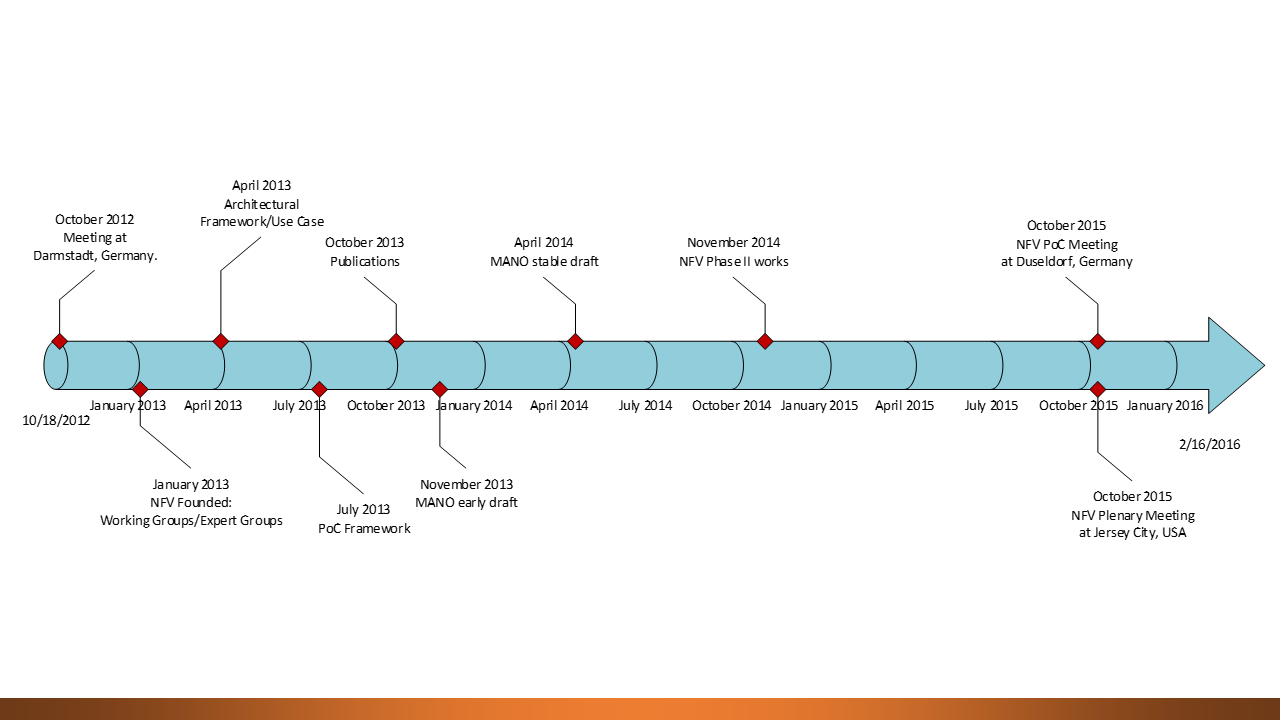
 
Figure 2. Timeline on NFV related research works at ETSI (source: ETSI, 2015; ETSI, 2014).

One more important subset of NFV framework is the NFVI (Network Function Virtualization Infrastructure). The NFVI specifies various physical resources and how abstraction of those resources are virtualized, e.g. virtual compute, virtual network and virtual storage. Applying our understanding of system virtualization (hypervisor/VM concept) [if you need further clarification, please visit my blog: http://www.dhimanchowdhury.blogspot.com/2015/07/network-virtualization-101-prelude.html ], the NFVI framework can be understood as hardware resources (compute, storage and network) virtualized by hypervisor for which VM is virtual instances and VNFs (Virtual Network Functions) are implemented as application on top of VMs. Please refer to the NFV reference model as depicted in figure 3. The NFV reference model comprises of three main subsets: NFVI, VNFs and NFV Management and Orchestration. The element management system (EMS) is commonly used in a typical telecom network to manage network element. In my good old Nortel days, we used element manager to retrieve configuration information in various networking and telecom gears while pulling device information through NMS. Once a device is found in the network using NMS network map, you could double click on the device to open up element manager to configure and manage the device in a way that is not possible through simply using MIBs as you would through the NMS. I hope this imparts you the usefulness and purpose of EMS. In a telecom network EMS brings many values, for example, you could integrate different vendors and their element manager to a NMS and manage the entire group of systems through a single NMS.

 
Figure 3. The NFV reference Model.

The OSS (Operational/Operation Support System) and BSS (Business Support Systems) are back-office software applications to supports activities related to services. For example, OSS includes software toolsets that are related to management and operation aspects of network services while BSS toolsets are used for billing, order management and CRM etc. For telecom professional these terms and software toolsets are nothing new but for rest of the readership this brief explanation is useful.

Now that we understand some key terms and functional elements that connects with NFV framework, let us explore essential components of NFV reference model. Please note that NFVI specifies hypervisor based virtualization but it is also possible to use containers (a notion mainly associated with LinuX Container) to support same VNF instances as in hypervisor/VM based system. The notion of container was born in 2005, out of necessities for webscale services at Google Data center. Google was experimenting with hypervisor based virtualization at the time but soon realized that performance penalty for such virtualization is too high and was not elastic enough to support a web-based services at scale (Bottomley, 2014). During the time, a group of engineers were working on Linux around a concept based on cgroup called process container who were later hired by Google to advance experimentation for webscale services. Some of these Cgroup technology later found its way into Linux Kernel and the LinuX Container (LXC) project was born in January 2008.
To date, implementation of containers are mainly done at server level system virtualization but works are underway to realize some benefits of container based virtualization at networking gears. As such, implementation of VNFs in networking switching gears may well be done using container virtualization techniques within next two years.

The VNFs (Virtual Network Functions) are simply network node or network functions (NF) running as virtual instance on top of VMs (virtual machines) (Vilalta, et al., 2014). For example, a VNF can be load balancer, NAT/firewall and many other similar network/network node functions. Today, much of the VNF implementations are done at server level but it is also possible to implement VNFs on networking gears. NFV framework (ETSI, 2014) did not constrained use case scenarios of VNFs and works are already underway to have server like experience in networking gears making it possible to implements VNFs in various use case scenarios, such as Residential, CDN, Fixed Access Networks, Mobile Station and Mobile Core & IMS deployments. This implies that even future residential or CPE gateways will have VNFs implemented on them allowing service providers to deploy service at will.

The Management and configuration of VNFs and other subsets of the NFV reference model (as depicted in figure 3) is done through MANO (Management and Orchestration) toolsets. The MANO architecture presents three elements: VIM (Virtual Infrastructure Manager), VNF manager and Orchestrator. The VIM is used for the management and allocation of virtual resources, e.g. add/remove and modification of resources related to compute, network and storage. The Openstack constitutes a close reality to ideal VIM but requires further works related to various plugins and integration of automation/configuration chef and puppet tools to realize its deployment in service provider network.

The VNF managers handle the configuration, lifecycle management, and element management of the virtualized network functions. Within Openstack initiative, the “Tracker” project aims to deliver VNF manger and NFV orchestration capabilities for NFV platforms. For further information on “Tracker”, please visit https://wiki.openstack.org/wiki/Tacker .
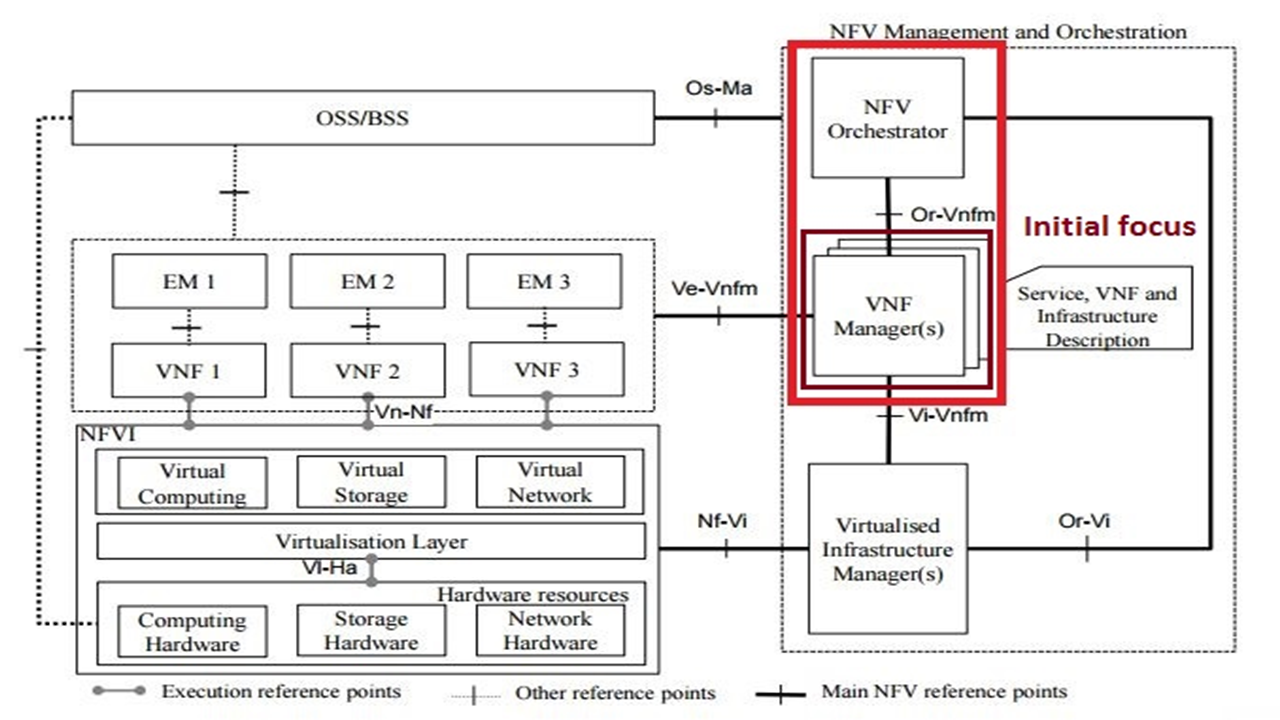
 
Figure 4. The diagrammatical representation of Openstack “Open NFV Orchestration” “Tracker” project focus. (Openstack, 2015).

Apart from the Openstack Tracker project, many other vendors also offer application solutions but challenges remain to develop a comprehensive toolsets due to complexities of unified transport networks systems.

I hope this article provided a brief overview of NFV reference model: readership should follow the work of ETSI at http://www.etsi.org/technologies-clusters/technologies/nfv  to advance their understanding and stay in touch with the latest works in this field.  In the next article, we will explore various APIS of SDN and understand how SDN and NFV are deployed in a given network scenario.

Please stay tune and follow me. If you are interested, please join me in the free live webinar on “Open Networking” at https://lnkd.in/bhydy6x .

Reference

[Bottomley, 2014] Bottomley, J., 2014. What is All the Container Hype? Parallels.

[Haleplidis et al., 2001] Haleplidis, E., Salim H. J., Denazis, S. & Koufopavlou, O, 2015. Towards a Network Abstraction Model for SDN. Network System Management (2015) 23:309-327.

[ETSI, 2014] ETSI, 2014. Network Functions Virtualisation – White Paper #3. ETSI NFV portal. Available online at https://portal.etsi.org/Portals/0/TBpages/NFV/Docs/NFV_White_Paper3.pdf

[ETSI, 2015] ETSI, 2015. NFV activity report 2014. ETSI NFV Portal. Available online at https://portal.etsi.org/TBSiteMap/NFV/ActivityReport.aspx

[Openstack, 2015] Openstack, 2015. Tacker. Available online at https://wiki.openstack.org/wiki/Tacker .

[Vilalta, et al., 2014] Vilalta, R., Muñoz, R., Casellas, R., Martínez, R., López, V., & López, D., 2014). Transport PCE network function virtualization. In European Conf. Optical Communications, Cannes, France.

Posted by Dhiman Chowdhury at 4:36 PM   

Labels: Cloud Architecture, Cloud Computing, Data Center Networking, Hybrid Cloud, NFV, Software Define Data Center

Thursday, September 3, 2015

Network Virtualization 101: The NV

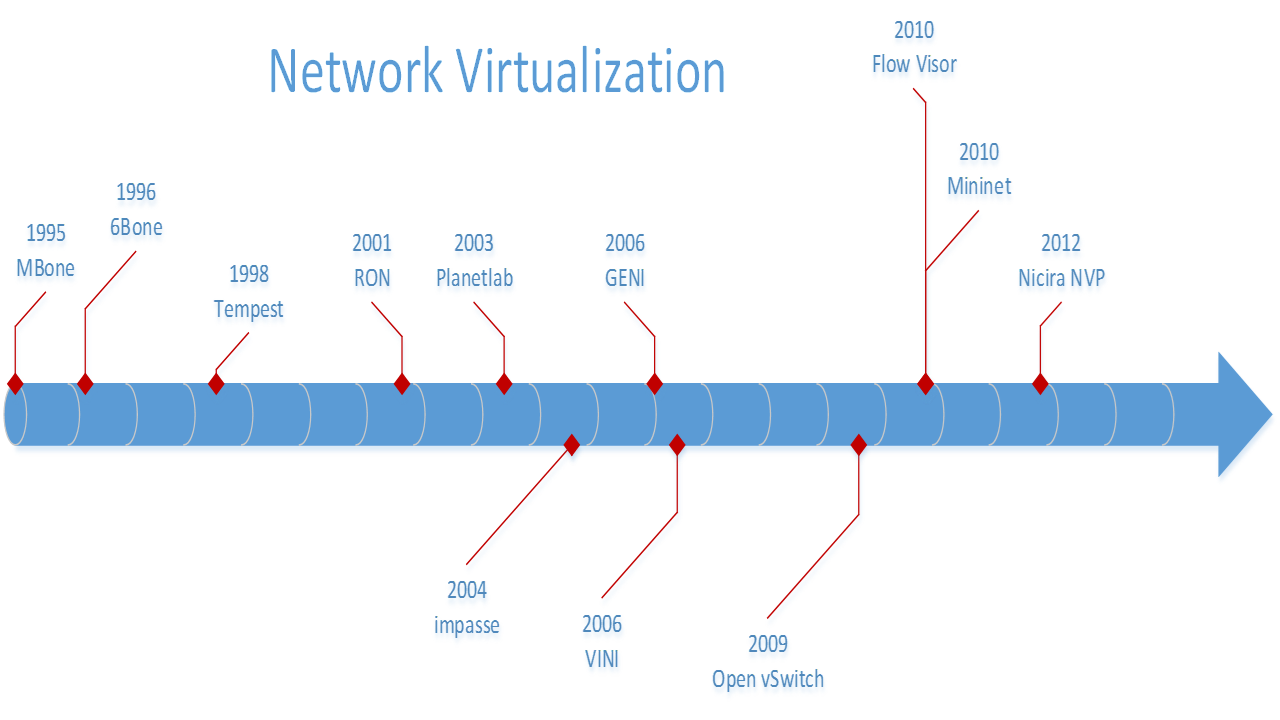
In previous article, I have discussed about historical perspective of Network virtualization ( http://www.dhimanchowdhury.blogspot.com/2015/07/network-virtualization-101-nve-overlay.html ): how the need to share resources and induce flexibility and programmability in network environment led to the series of research undertakings, e.g. MBone project (Almeroth, C.K., 2000) – an experimental backbone project for carrying IP “multicast” that was developed in 1994. If you have not read that article, I suggest that you do: it will help you understand the development in network virtualization and benefits thereof.

Figure 1. Timeline of Network Virtualization.

This article is third in the “Network Virtualization 101” series.

In the previous article, I presented a review of network programmability works in four stages rather than in chronological order: three stages were discussed in earlier section and the fourth “network virtualization” (NV) is presented herein as follows.

The notion of “network virtualization” (NV) can be understood as decoupling physical topology from logical topology (e.g., Overlay networks) and as such, implementation does not require SDN. Similarly, the common notion of SDN (separation of control plane and data plane) does not require network virtualization. This distinction is important since many may be confuse by the symbiotic nature in which network virtualization and SDN relate (Feamster, N., Rexford, J. & Zegura, E., 2014):

  •          SDN as enabling technology: with the advent of cloud computing, service providers faced the challenge to share and isolate resources to multiple tenants in a way that make best use of available network infrastructure. A common method to share such isolation at VM level is to use overlay networks through protocols such as VxLAN and NVGRE. While VxLAN and/or NVGRE does not require SDN to implement but having the capability to provision the network for VxLAN and/or NVGRE from centralized server surely helpful.  Another example of SDN as an enabling is Nicira’s network virtualization platform or NVP.  The NVP framework implements Open vSwitch (a virtual switching platform), a controller and South bound API to facilitate network transport. The Open vSwitch is hardware agnostic and can be implemented in servers without the need for networking gears.
  •         Slicing or virtualizing an SDN: A hybrid switch for example implements both traditional protocol suits and OF (OpenFlow) agents and other flow control APIs. With appropriate arbitration mechanisms, network flow can be logically separated from other logical instances of network. Similarly, Flowvisor (a special purpose controller that works as transport proxy between OF agent and OF controller) allows slicing of network resources and delegates control of each slice to a different controller (Flowvisor, 2014).

From historical perspective, the work on Network virtualization can be predated to the early days of MBone experiment. The MBone otherwise known as “Multicast Backbone” is a virtual network built on top of internet. It was invented by Van Jacobson, Steve Deering and Stephen Casner in 1992 as part of an undertaking by IETF (Internet Engineering Task Force).  In the early 1990s, majority of the routers in the internet did not support IP Multicasting and packets were transported through IP unicast. As a result one-to-many communication was difficult. The solution was MBone or “Multicast Backbone” in which multicast function provided by workstation running a daemon process known as “mrouted” (Almeroth, 2000). Workstation running “mrouted” process is known as “mrouter” (essentially a multicast router). These mrouters are than placed in special group of LAN or single LAN that are multicast capable. The “mrouted” process received unicast-encapsulated multicast packets on an incoming interface and then forwarded packets over the appropriate set of outgoing interfaces. Connectivity among these machines was provided using point-to-point, IP-encapsulated tunnels. Each tunnel is connected two endpoints via one logical link. The routing decisions were made using DVMRP (Distance Vector Routing Protocol) as shown the figure below.

Figure 2. MBone topology during the early years of its deployment.

The DVMRP since then replaced by PIM (Protocol Independent Multicast) helping MBone to be integrated with internet than its initial attempts. For many years, network equipment supported the creation of virtual networks, e.g. VLAN which allows the creation of multiple logical networks on top of physical topology. But such network virtualization is limited to L2 network segments and impedes on the deployment of new technologies traversing across the network. To overcome this, researchers and practitioner resorted to running overlay networks which allows endpoint nodes to run their own control plane and forward data traffic and control-plane message across the networks traversing multi hop L3 networks.  The MBone (for multicast) and 6Bone (for IPV6) are example of such overlay network virtualization. In the previous article, I discussed example of overlay network architecture and some of the protocol used for tunneling and will explore this further in the succeeding articles about network virtualization configurations. The complete survey of network virtualization is cumbersome, however, the historical perspective I am presenting herein, though brief, is important in the research of network programmability (SDN) and in the gradual development of programmable and dynamic network systems. It is to be noted both SDN and network virtualization is tightly coupled despite their distinctions. Programmable network (i.e. SDN) often presume “network virtualization” as an integral part to share network infrastructure for multi-tenant services supporting logical network topologies that differ from physical network. The early overlay network that is essential in evaluating and understanding “network virtualization” often used dedicated nodes running special protocols. The notion of such early day overlay network soon expanded to include any host computer that run special application in hope of supporting peer to peer file sharing application (e.g. Napster; Wikipedia, 2015). The research on peer to peer networking reignited interest and research works in the development of robust overlay network technologies. An example of such work is “Resilient Overlay Networks” (Andersen et al., 2015) in which a small number of network nodes form overlay network detecting network failure and recovering quickly from network issues and performance problem. Since overlay network does not require any special equipment (unlike Active network; please refer to my previous article), researchers began building experimental infrastructure like Planetlab (Peterson et al., 2002) to support wider research works on network virtualization. Interestingly, PlanetLab itself was a form of “programmable router/switch” active networking, but using a collection of servers rather than the network nodes, and offering programmers a conventional operating system (i.e., Linux) (Feamster, N., Rexford, J. & Zegura, E., 2014). The project of GENI (GENI, 2015) took this notion of programmable virtual network infrastructure to next level supporting much large scale national experimental for research in networking and distributed system.

Figure 3. GENI – The vast experimental virtualized network infrastructure project (GENI, 2015). Figure (Courtsey, GENI, 2015).

If you are interested in experimenting your concept in a virtualized network infrastructure, please visit http://groups.geni.net/geni/wiki/GENIConcepts and join the project.

Considering the project like GENI, one can easily perceive the potential of network virtualization. Some researchers argued that network virtualization is key to next generation internet architecture. In the first article of this series, discussing about NVE (Network Virtualization Environment) I explored the theoretical connotations from various scholars regarding the need for next generation internet and service provider network in which multiple network architectures can coexist at the same time (each optimized for different applications or requirements, or run by different business entities), and evolve over time to meet changing needs (Feamster, N., Rexford, J. & Zegura, E., 2014; Carapinha & Jiménez, 2009; Chowdhury & Boutaba, 2009; Chowdhury & Boutaba, 2008).

I hope this brief overview of NV (Network Virtualization) is helpful in understanding the difference and dependencies between network virtualization and SDN and the importance of network virtualization in future network design. You will find the basic understanding helpful in the succeeding articles about network architecture and configurations.

In the next article, I will extend the notion of Network Virtualization to VNF (Virtual Network Function) and NFV (Network Function Virtualization).  Please stay tune and follow me at linkedin (https://www.linkedin.com/in/dhiman1 ), twitter @dchowdhu ( https://twitter.com/dchowdhu ) and google plus (https://plus.google.com/u/0/+DhimanChowdhury/posts ). You may also subscribe to all these feeds through Agema System’s linkedin page at https://www.linkedin.com/company/agema-systems-inc?trk=top_nav_home

Reference

[Almeroth, C.K., 2000] Almeroth, C.K., 2000. The Evolution of Multicast: From the MBone to Interdomain Multicast to Internet2 Deployment. IEEE Network. Available online at http://www.cs.ucsb.edu/~almeroth/classes/F05.276/papers/evolution.pdf .

[Andersen et al., 2001] Andersen, D. G., Balakrishnan, H., Kaashoek, M. F. & Morris, R., 2015. Resilient Overlay Networks. In Proc. 18th ACM Symposium on Operating Systems Principles (SOSP), pages 131–145, Banff, Canada, Oct. 2001.

[Carapinha, J. & Jiménez, J. 2009] Carapinha, J. & Jiménez, J. 2009. VISA ’09 Proceedings of the 1st ACM workshop on Virtualized infrastructure systems and architectures. The ACM Digital Library.

[Chowdhury, K.M.M.N. & Boutaba, R., 2008 ] Chowdhury, K.M.M.N. & Boutaba, R., 2008. A Survey of Network Virtualization. Technical Report CS-2008-25. University of Waterloo.

[Chowdhury, K.M.M.N. & Boutaba, R., 2009 ] Chowdhury, K.M.M.N. & Boutaba, R., 2009. Network Virtualization: State of the Art and Research Challenges. IEEE COMMUNICATIONS MAGAZINE.

[Clark et al., 2006] Clark, D., Lehr, B., Bauer, S., Faratin, P., Sami, R. & Wroclawski, J., 2006. Overlay Networks and the Future of the Internet. Communications & Strategies, no. 63, 3rd quarter 2006, p. 109.

[Feamster, N., Rexford, J. & Zegura, E., 2014] Feamster, N., Rexford, J. & Zegura, E., 2014. The Road to SDN: An Intellectual History of Programmable Networks. ACM Queue, 2014.

Flowvisor, 2014. Flowvisor. Atlassian Confluence Open Source Project: University of Stanford. Available online at https://openflow.stanford.edu/display/DOCS/Flowvisor

[Feamster et al., 2004] Feamster, N., Balakrishnan, H., Rexford, J., Shaikh, A. & van der Merwe, J., 2004. The Case for Separating Routing from Routers. SIGCOMM’04 Workshops, Aug. 30-Sept. 3, 2004, Portland, Oregon, USA.

[GENI, 2015] GENI: Global Environment for Network Innovations. Available online at http://www.geni.net/.

[Peterson, et al., 2002] Peterson, L., Anderson, T., Culler, D. & Roscoe, T., 2002. A Blueprint for Introducing Disruptive Technology into the Internet. Planet Lab. Proceedings of the First ACM Workshop on Hot Topics in Networks (HotNets-I), Princeton, NJ, October 2002.

[Wikipedia, 2015]. Wikipedia, 2015. Napster. Wikipedia: The free Encyclopedia. Available online athttps://en.wikipedia.org/wiki/Napster

Network Virtualization 101: The NV

In previous article, I have discussed about historical perspective of Network virtualization ( http://www.dhimanchowdhury.blogspot.com/2015/07/network-virtualization-101-nve-overlay.html ): how the need to share resources and induce flexibility and programmability in network environment led to the series of research undertakings, e.g. MBone project (Almeroth, C.K., 2000) – an experimental backbone project for carrying IP “multicast” that was developed in 1994. If you have not read that article, I suggest that you do: it will help you understand the development in network virtualization and benefits thereof.

 
Figure 1. Timeline of Network Virtualization.

This article is third in the “Network Virtualization 101” series.

In the previous article, I presented a review of network programmability works in four stages rather than in chronological order: three stages were discussed in earlier section and the fourth “network virtualization” (NV) is presented herein as follows.

The notion of “network virtualization” (NV) can be understood as decoupling physical topology from logical topology (e.g., Overlay networks) and as such, implementation does not require SDN. Similarly, the common notion of SDN (separation of control plane and data plane) does not require network virtualization. This distinction is important since many may be confuse by the symbiotic nature in which network virtualization and SDN relate (Feamster, N., Rexford, J. & Zegura, E., 2014):

  •          SDN as enabling technology: with the advent of cloud computing, service providers faced the challenge to share and isolate resources to multiple tenants in a way that make best use of available network infrastructure. A common method to share such isolation at VM level is to use overlay networks through protocols such as VxLAN and NVGRE. While VxLAN and/or NVGRE does not require SDN to implement but having the capability to provision the network for VxLAN and/or NVGRE from centralized server surely helpful.  Another example of SDN as an enabling is Nicira’s network virtualization platform or NVP.  The NVP framework implements Open vSwitch (a virtual switching platform), a controller and South bound API to facilitate network transport. The Open vSwitch is hardware agnostic and can be implemented in servers without the need for networking gears.
  •         Slicing or virtualizing an SDN: A hybrid switch for example implements both traditional protocol suits and OF (OpenFlow) agents and other flow control APIs. With appropriate arbitration mechanisms, network flow can be logically separated from other logical instances of network. Similarly, Flowvisor (a special purpose controller that works as transport proxy between OF agent and OF controller) allows slicing of network resources and delegates control of each slice to a different controller (Flowvisor, 2014).


From historical perspective, the work on Network virtualization can be predated to the early days of MBone experiment. The MBone otherwise known as “Multicast Backbone” is a virtual network built on top of internet. It was invented by Van Jacobson, Steve Deering and Stephen Casner in 1992 as part of an undertaking by IETF (Internet Engineering Task Force).  In the early 1990s, majority of the routers in the internet did not support IP Multicasting and packets were transported through IP unicast. As a result one-to-many communication was difficult. The solution was MBone or “Multicast Backbone” in which multicast function provided by workstation running a daemon process known as “mrouted” (Almeroth, 2000). Workstation running “mrouted” process is known as “mrouter” (essentially a multicast router). These mrouters are than placed in special group of LAN or single LAN that are multicast capable. The “mrouted” process received unicast-encapsulated multicast packets on an incoming interface and then forwarded packets over the appropriate set of outgoing interfaces. Connectivity among these machines was provided using point-to-point, IP-encapsulated tunnels. Each tunnel is connected two endpoints via one logical link. The routing decisions were made using DVMRP (Distance Vector Routing Protocol) as shown the figure below.

 
Figure 2. MBone topology during the early years of its deployment.


The DVMRP since then replaced by PIM (Protocol Independent Multicast) helping MBone to be integrated with internet than its initial attempts. For many years, network equipment supported the creation of virtual networks, e.g. VLAN which allows the creation of multiple logical networks on top of physical topology. But such network virtualization is limited to L2 network segments and impedes on the deployment of new technologies traversing across the network. To overcome this, researchers and practitioner resorted to running overlay networks which allows endpoint nodes to run their own control plane and forward data traffic and control-plane message across the networks traversing multi hop L3 networks.  The MBone (for multicast) and 6Bone (for IPV6) are example of such overlay network virtualization. In the previous article, I discussed example of overlay network architecture and some of the protocol used for tunneling and will explore this further in the succeeding articles about network virtualization configurations. The complete survey of network virtualization is cumbersome, however, the historical perspective I am presenting herein, though brief, is important in the research of network programmability (SDN) and in the gradual development of programmable and dynamic network systems. It is to be noted both SDN and network virtualization is tightly coupled despite their distinctions. Programmable network (i.e. SDN) often presume “network virtualization” as an integral part to share network infrastructure for multi-tenant services supporting logical network topologies that differ from physical network. The early overlay network that is essential in evaluating and understanding “network virtualization” often used dedicated nodes running special protocols. The notion of such early day overlay network soon expanded to include any host computer that run special application in hope of supporting peer to peer file sharing application (e.g. Napster; Wikipedia, 2015). The research on peer to peer networking reignited interest and research works in the development of robust overlay network technologies. An example of such work is “Resilient Overlay Networks” (Andersen et al., 2015) in which a small number of network nodes form overlay network detecting network failure and recovering quickly from network issues and performance problem. Since overlay network does not require any special equipment (unlike Active network; please refer to my previous article), researchers began building experimental infrastructure like Planetlab (Peterson et al., 2002) to support wider research works on network virtualization. Interestingly, PlanetLab itself was a form of “programmable router/switch” active networking, but using a collection of servers rather than the network nodes, and offering programmers a conventional operating system (i.e., Linux) (Feamster, N., Rexford, J. & Zegura, E., 2014). The project of GENI (GENI, 2015) took this notion of programmable virtual network infrastructure to next level supporting much large scale national experimental for research in networking and distributed system.


Figure 3. GENI – The vast experimental virtualized network infrastructure project (GENI, 2015). Figure (Courtsey, GENI, 2015).

If you are interested in experimenting your concept in a virtualized network infrastructure, please visit http://groups.geni.net/geni/wiki/GENIConcepts and join the project.

Considering the project like GENI, one can easily perceive the potential of network virtualization. Some researchers argued that network virtualization is key to next generation internet architecture. In the first article of this series, discussing about NVE (Network Virtualization Environment) I explored the theoretical connotations from various scholars regarding the need for next generation internet and service provider network in which multiple network architectures can coexist at the same time (each optimized for different applications or requirements, or run by different business entities), and evolve over time to meet changing needs (Feamster, N., Rexford, J. & Zegura, E., 2014; Carapinha & Jiménez, 2009; Chowdhury & Boutaba, 2009; Chowdhury & Boutaba, 2008).

I hope this brief overview of NV (Network Virtualization) is helpful in understanding the difference and dependencies between network virtualization and SDN and the importance of network virtualization in future network design. You will find the basic understanding helpful in the succeeding articles about network architecture and configurations.

In the next article, I will extend the notion of Network Virtualization to VNF (Virtual Network Function) and NFV (Network Function Virtualization).  Please stay tune and follow me at linkedin (https://www.linkedin.com/in/dhiman1 ), twitter @dchowdhu ( https://twitter.com/dchowdhu ) and google plus (https://plus.google.com/u/0/+DhimanChowdhury/posts ). You may also subscribe to all these feeds through Agema System’s linkedin page at https://www.linkedin.com/company/agema-systems-inc?trk=top_nav_home

Reference

[Almeroth, C.K., 2000] Almeroth, C.K., 2000. The Evolution of Multicast: From the MBone to Interdomain Multicast to Internet2 Deployment. IEEE Network. Available online at http://www.cs.ucsb.edu/~almeroth/classes/F05.276/papers/evolution.pdf .

[Andersen et al., 2001] Andersen, D. G., Balakrishnan, H., Kaashoek, M. F. & Morris, R., 2015. Resilient Overlay Networks. In Proc. 18th ACM Symposium on Operating Systems Principles (SOSP), pages 131–145, Banff, Canada, Oct. 2001.

[Carapinha, J. & Jiménez, J. 2009] Carapinha, J. & Jiménez, J. 2009. VISA ’09 Proceedings of the 1st ACM workshop on Virtualized infrastructure systems and architectures. The ACM Digital Library.

[Chowdhury, K.M.M.N. & Boutaba, R., 2008 ] Chowdhury, K.M.M.N. & Boutaba, R., 2008. A Survey of Network Virtualization. Technical Report CS-2008-25. University of Waterloo.

[Chowdhury, K.M.M.N. & Boutaba, R., 2009 ] Chowdhury, K.M.M.N. & Boutaba, R., 2009. Network Virtualization: State of the Art and Research Challenges. IEEE COMMUNICATIONS MAGAZINE.

[Clark et al., 2006] Clark, D., Lehr, B., Bauer, S., Faratin, P., Sami, R. & Wroclawski, J., 2006. Overlay Networks and the Future of the Internet. Communications & Strategies, no. 63, 3rd quarter 2006, p. 109.

[Feamster, N., Rexford, J. & Zegura, E., 2014] Feamster, N., Rexford, J. & Zegura, E., 2014. The Road to SDN: An Intellectual History of Programmable Networks. ACM Queue, 2014.

Flowvisor, 2014. Flowvisor. Atlassian Confluence Open Source Project: University of Stanford. Available online at https://openflow.stanford.edu/display/DOCS/Flowvisor

[Feamster et al., 2004] Feamster, N., Balakrishnan, H., Rexford, J., Shaikh, A. & van der Merwe, J., 2004. The Case for Separating Routing from Routers. SIGCOMM’04 Workshops, Aug. 30-Sept. 3, 2004, Portland, Oregon, USA.

[GENI, 2015] GENI: Global Environment for Network Innovations. Available online at http://www.geni.net/.

[Peterson, et al., 2002] Peterson, L., Anderson, T., Culler, D. & Roscoe, T., 2002. A Blueprint for Introducing Disruptive Technology into the Internet. Planet Lab. Proceedings of the First ACM Workshop on Hot Topics in Networks (HotNets-I), Princeton, NJ, October 2002.


 [Wikipedia, 2015]. Wikipedia, 2015. Napster. Wikipedia: The free Encyclopedia. Available online athttps://en.wikipedia.org/wiki/Napster