Network Transformation is in the offing: Does disaggregation model help?

One of the fascinating aspects in my job is understanding how some of world’s largest networks will deploy Open networking platforms. It is this continuous learning that keeps me passionate about what I do.  When I first use “open networking” term, people wondered what it may entails.  Some thought of it is all about using “open source” software and the other thought of it as another connotation of confusing technical term that simply add to plethora of jargons.  Interestingly, open networking is none of the said. It is about disaggregating hardware and software in a way that allows relatively easier integration of each sub systems. In doing so, the model innately provides three distinct benefits to customers:

  1. Eliminates Vendor lock-in: There is no need to be enchained by vendor or vendors. With state of the art merchant silicon available off the shelf, benefits of technology can be realized without being locked into a specific vendor device.
  2. Cost Reduction: As more and more vendors join the marketplace, price of hardware and software becomes suddenly more affordable. This innately reduces CAPEX and OPEX for customers.
  3. Choice of HW and Software: The disaggregation model in which open networking conception is born innately provides a choice for customers on hardware and software.


Figure 1‑1. Open Networking: Disaggregation model.

Central to open networking is the disaggregation model that allows hardware and software vendors to deliver their capability on what they do best. For example, hardware vendor can bring best breed of technology from modularization of their platform to make use of state of the art market silicons and on the other hand, software vendors to offer best NOS (Network Operating Systems) or software means for data plane and control plane separation.  In doing so, the marketplace has created an apparently robust eco-chain. Some will disagree here but the fact remains that the eco-chain is improving and some parts of it is more realistic now then perhaps a year before. To be more specific, I have elaborated the eco-chain in the figure below. Rather than referring it to open networking eco-chain, I denoted it as “SDN eco-chain” since the central to this initiative is about making network more programmable and service aware.


Figure 1‑2. Typical SDN Eco-chain.

The programmability is the core element of SDN (Software Defined Networking) for which pundits advocated the decoupling of control and data plane. However, programmability can be done in many ways: through ZTP (Zero touch provisioning), APIs (e.g. Netconf) and OpenFlow protocol (a more conventional notion of decoupling).

To my experience, majority of network deployments thus far refrained from purely decoupling model but there are exceptions and distinct differences in deployment. For example, FBOSS that runs as agent daemon uses thrift API instead of openflow to communicate route information with controller. Details of this opensource decoupling software is available at https://github.com/facebook/fboss .

Service Providers are more interested about CAPEX and OPEX reduction with choice and flexibility that open networking offers. For example, a provider edge switch that offers flexibility of advance MPLS networks with APIs for model based network configuration and monitoring could best fit their immediate need of transforming networks as oppose to overhauling the network in one go using decoupling of data and control plane. It is in this phased transformation, open networking offers best value but it is not confined by the said as it is encompassing to traditional networks and decoupling of data and control plane.

I conjectured even a bigger picture for “Open networking” as it is the fundamental conduit of future network transformation. For it, disaggregation model is paving the way for a more sophisticated network transformation to occur. A vision towards that end would be “Intelligent Networks” one that is provisionable in click, intent-based and self-healed, to name few attributions.
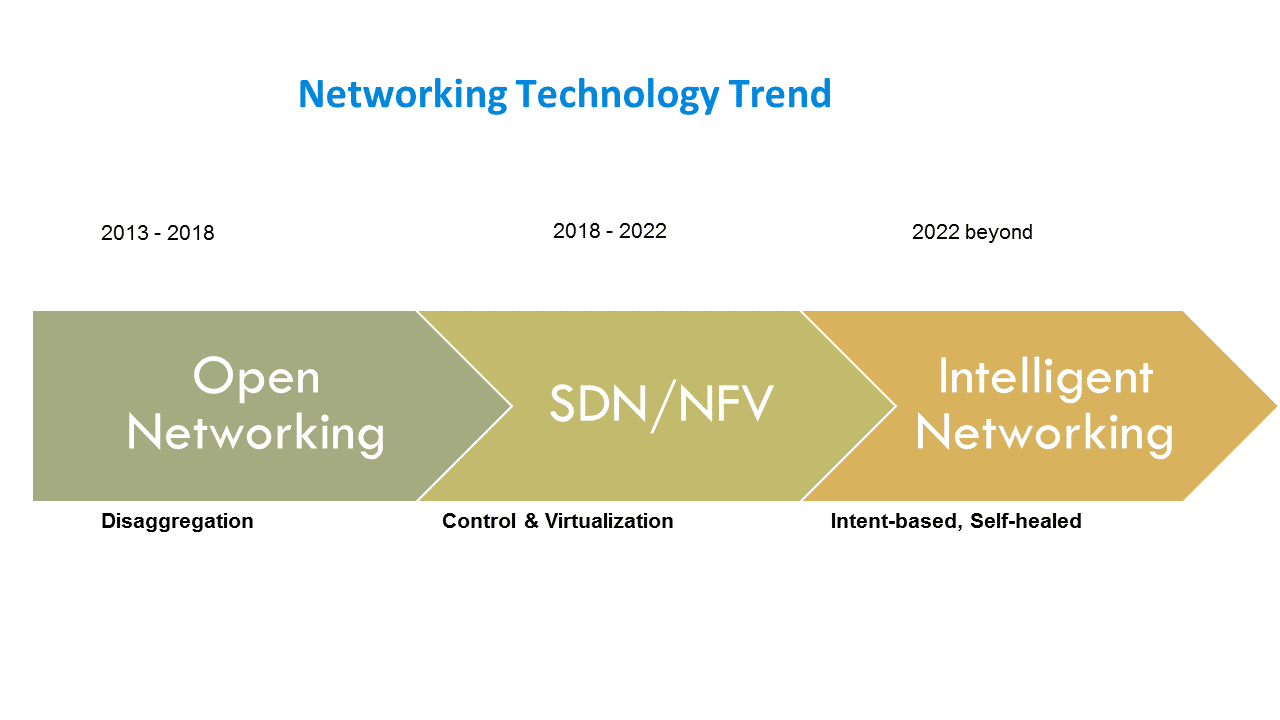
Figure 1‑3. Networking Technology Trend.

Affordability, openness and choices are big factors in network transformation especially for service providers since disaggregation model is giving them ability to deliver more service at a fraction of cost that would otherwise be. Moreover, open networking is offering best of both world, the “traditional” and “NextGen”. For example, in a given network deployment scenario customer may prefer to choose their own NOS depending upon southbound API requirements and L2/L3 switching products. A NOS that combines both APIs and decoupling protocols such OpenFlow is known hybrid NOS. The goal here would be two folds, first allow traditional network protocols such BGP to be run at NOS level forming traditional routing architecture and secondly, network topology is passed to Openstack for visibility, orchestration and management. The following picture depicts how such nextgen network abstraction can coexist with traditional networks.

Figure 1‑4. Cloudification of Network.

Telemetry at each network device can be obtained through Broadview™, an opensource software contributed by Broadcom®. Such deployment not only allows physical networks to be virtualized and cloudified, it is done so without compromising backward compatibility of physical network and the traditional network routing architecture therein. The depiction herein is forward looking and implementation of such network is at the discretion of its designer and availability of suitable hybrid NOS. However, this notion of network cloudification is possible only due to advances in open networking and the eco-chain that supports it.

This article is provided herein for educational purpose only implying the importance of “Open Networking” and how disaggregation model helps in realizing NextGen network transformation.

SDN API and Protocols: ForCES (Forwarding and Control Element Separation)

This article is part of my “Network Virtualization 101” series. For other articles in this series, please visit http://www.dhimanchowdhury.com or my blog athttp://www.dhimanchowdhury.blogspot.com .

SDN (Software Defined Networking) is much of a buzz word now a days; for some it is simply decoupling of control and data plane but for others, it is an encompassing abstraction for cloudification. If you scratching your head, you are not alone. Well, simplistic purview may be decoupling but the sole purpose is network programmability. So as it goes, the work of network programmability developed into the notion of decoupling as a means to attain network programmability. Thus relating SDN to that degree of granularity is important to understand why industry is pondering over so many opensource projects and why protocol such as OpenFlow are gaining momentum so quickly as de-facto south bound protocol. The popularity of Opendaylight and Ryu controllers surely made OpenFlow a well-known name and most sought after as southbound protocol for network programmability. But does this mean, OpenFlow is the best solution there is for southbound protocol?

In this article, I am introducing somewhat forgotten yet an important framework and protocol for Control and Data plane separation (decoupling), “ForCES (Forwarding & Control Element Separation)”. The ForCES is an undertaking of IETF (Internet Engineering Task Force) and defined through a number of RFCs (Request for Comments). In my previous article at https://www.linkedin.com/pulse/network-virtualization-101-nve-overlay-sdn-dhiman-chowdhury?trk=pulse_spock-articles , I discussed about the historical significance of ForCES. It is important to note, the notion of decoupling originated from the scholarly works of ForCES led to the research work of Ethane project in 2007 and OpenFlow in 2008. The following diagram depicts the timeline for each.

Figure 1: Timeline depicting historical significance of ForCES.
In the early experimentations, scholars proposed the notion of separating control and data plane for networking processor (Olsson, et al., n.d.) [1], which pave the way for programmable networks or programmability in network devices. Today the context is further expanded to network design and architecture of NextGen networks. It is a good idea and in fact essential for future of networking. However, there are major predicaments to such abstraction e.g. network latency and scalability issues especially when control element is centralized and separated from data plane. This concern bogged down the wide spread deployment of some of the commonly used protocols such as OpenFlow which relies mainly on wildcard matches to push “packet flows” rules to the networking device. Such approach requires that wildcard matches are applied through TCAMs in the switch.
TCAM (Ternary Content Addressable Memory) and OpenFlow Issues
The TCAM (Ternary Content Addressable Memory) is a specialized high speed memory that allows searches of entire content within single clock-cycle. However, TCAM size are often limited in network devices due high cost of external TCAMs and thus such approach limits the number of flow table entries can be applied on a network device raising the question for scalability (Braun & Menth, 2014) [2].
All is not bad, whitebox are good news for OpenFlow implementation as some of these products are implementing server like capabilities packed in 1 RU box with increase CPU capacity, memory and TCAM sizes (Bifulco & Matsiuk, 2015) [3]. For example, Agema’s AGC7648 family of product supports two external TCAMs supporting more than 1.25 Millions IPV4 routes lookup. The AGC7648 combines a relatively powerful CPU with internal 750k UFT (Unified Forwarding table) on the switching chip, two external TCAMs and 6Gbytes of external port buffer. Enough horse power packed in 1 RU size box. In such platform, OpenFlow controller has better chance implementing significant number of flows than products without external TCAMs. However, question of latency and performance are still a big challenge for OpenFlow based Deployment despite the claim that OF-TTP (OpenFlow Table Type Patern) resolves scalability and performance issues.
Bifulco & Matsiuk (2015) argue that combination of software based switching function (which they denote as shadow switch) [3] and TCAM will highly improve throughput in OpenFlow deployment and thus the proposal addresses the concern for performance.
Why ForCES?
Some scholars consider wildcard matches that requires significant TCAM size on networking devices is a handicap approach. Bifulco & Matsiuk, 2015 [3] think such drawback can be improved through a combination of software switching function and TCAM to increase overall throughput. An alternative to OpenFlow in networking programmability field, Haleplidis et al (2015) [4] argue is ForCES. Though it remain experimental at Academic world for elastic routing architecture, it lack of presence in commercial world does not make it bad alternative. It may even surprise you knowing that some of world’s largest service providers, and to my knowledge, few mega data centers are deploying ForCES framework. There are few startups have either developed ForCES based controller and/or working towards developing it.
To this abstraction, you may find this news interesting:https://www.sdxcentral.com/articles/news/verizon-uses-radisys-mojatatu-sdn-nfv/2016/06/ .
The ForCES provides a framework and defines open API/protocols that clearly separate control and forwarding planes. Although many such API/protocols has been developed and/or proposed (.e.g. OpenFlow and RestAPI), the real strength of ForCES lies with its model which enables the description of new data-path functionality without changing the protocol between the control and forwarding plane (Haleplidis et al, 2015) [4]. In contrast, OpenFlow requires implementation of defined protocol at controller and Forwarding plane (e.g. OpenFlow agent at networking device). ForCES extend the notion of elastic routing architecture with belief that data plane packet processing may need additional functionalities programmed in the future while the switches are deployed in the network. This abstraction innately differentiate it from other existing SDN protocols/APIs such as OpenFlow.
In my suggestion, ForCES serves as a good framework upon which to develop elastic routing architecture for networking devices considering forwarding elements and control elements part of a system. In that way, centralized controller and networking devices are capable of exchanging capabilities and be part of an elastic routing architecture system.
ForCES Framework

IETF formed ForCES Working group in 2001during the time of dedicated network processor and that led to its main objective of standardizing open programmable interfaces for off-the-shelf Network processor devices. However, the framework was later influenced by programmable network and the IEEE P1520 initiatives [Tourrilhes, 2014] [5].

Figure 2:  ForCES Timeline: a brief overview.

 Several RFCs were written since then as depicted in the timeline above. The following table shows the list of ForCES RFCs and their purposes.

Table 1: ForCES RFC Information.

 In ForCES framework, the elastic routing architecture or network element (NE) comprises of two parts FE (Forwarding Element) and CE (Control Element). Both of these elements are implemented through ForCES Agent which includes a set of protocols and models.

Figure 3: ForCES Framework.

The ForCES framework allows developers to define their own FE abstraction models for implementation. This does not constrained CE to control and manage ForCES-modeled FEs. More importantly, ForCES framework is also protocol agnostic meaning a vendor may choose to use a traditional networking protocol to communicate between CEs and FEs. In theory, CE can implement routing protocols like OSPF and BGP and packets that cannot be handled by FEs are redirected to CEs (Haleplidis et al, 2015) [4].
ForCES Protocol

RFC5810 suggests two essential elements of ForCES Protocol for communication between FEs and CEs: PL (Protocol Layer) and TML (Transport Mapping Layer). The Protocol Layer (PL) is infact ForCES protocol which relies on TML like TCP and other underlying transport protocols for communication between FEs and CEs.

 Figure 4: ForCES Protocol Implementation.

The implementation of PL and TML may differ between control plane and management plane and in high availability scenarios. Figure 5 shows various interface point that are referenced in RFC5810 and behavior of PL/TML are also suggested accordingly in the RFC. A further discussion about those reference interfaces are available in RFC 3746.

FEs relies on underlying hardware abstraction layer for utilizing hardware resources to process packets. The handling of packets are directed either by a single controller or multiple controllers over ForCES Interface depending upon network deployment. The ForCES interface (herein PL and TML: please refer figure 4) may deploy either TCP or UDP for communication between FE and CE. For example, a ForCES implementation may choose to use TCP port 6653 (similar to OpenFlow) for communication between FE and CE.

Figure 5: ForCES interfaces in a high availability scenario as defined in RFC5810.

One important distinction between OpenFlow and ForCES is the use of logical functional block (LFB) in FE which allows several functions including packet processing and capability exchange.  Rather than treating network device as dumb (as in OpenFlow implementation), ForCES allows capability exchange to occur between CE and FE as depicted in figure 6.  As such, FE could reach out to CE, indicating its ability or inability to process a packet. In cases where FE is unable to process a packet perhaps due to lack of underlying hardware support, e.g. VxLAN or MPLS, CE will perform the function on behalf of the FE.

Figure 6: Implementation of LFB and capability exchange between FE and CE.

Such implementation of capability and state exchanges are important consideration for NextGen architecture and could serve as an ideal framework upon which a true elastic routing architecture can be developed.
In summary, I would recommend developers and vendors to explore further on ForCES specific framework for the development of NextGen elastic routing architecture, one that can be implemented in a single chassis (as in ForCES) as well in disaggregation model in which CE is implemented in server base controller and FE is implemented in networking device. More importantly, learning from ForCES should be applied towards developing a flexible routing architecture that make use of traditional routing and transport protocol as well allows network devices and controller to exchanges capability parameters. The work of ForCES worth the praise and really an outstanding framework for elastic routing architecture development.

Reference:

[1] Olsson, R., Hagsand, O., Laas, J. & Gorden, B.,  n,.d. Control and forwarding-plane separation of an open-source router. Uppsala University and KTH. Available online athttp://www.inter.uadm.uu.se/digitalAssets/21/21239_opensourcerouting.pdf .
[2] Braun, W. & Meth, M., 2014. Software-Defined Networking Using OpenFlow: Protocols, Applications and Architectural Design Choices. Future Internet 2014, 6, 302-336; doi:10.3390/fi6020302.
[3] Bifulco R., & Matsiuk, A., 2015. Towards Scalable SDN Switches: Enabling Faster Flow Table Entries Installation. SIGCOMM ’15 August 17-21, 2015, London, United Kingdom.
[4] Haleplidis, E., Salim, J.H., Halpern, J.M., Hares, S., Pentikousis, K., Ogawa, K., Wang, W., Denazis, S. & Koufopavlou, O., 2015. Network Programmability With ForCES. IEEE COMMUNICATION SURVEYS & TUTORIALS, VOL. 17, NO. 3, THIRD QUARTER 2015.
[5] Tourrilhes, J., Sharma, P., Banerjee, S. & Pettit, J., 2014. SDN and openflow evolution: A standards perspective. Computer, vol. 47, no. 11, pp. 22–29, Nov. 2014

Network Virtualization 101: SDN APIs and Protocols

This article is part of my SDN/network virtualization series “Network Virtualization 101”. To view other articles in this series and/or learn more about SDN and network virtualization, please visithttps://www.linkedin.com/today/author/0_1J4WrxUu5ZhIszQwsUUcg_?trk=prof-sm or http://www.dhimanchowdhury.blogspot.com .
From the simplistic purview, SDN (Software Defined Networking) provides the means of dynamism in “networking infrastructure” solutions by facilitating programmable network control, centralized management and orchestration. For network control, it decouples control plane (think of it in terms of a set of conventional applications/protocol suits e.g. Firewall, NAT, load balancer and BGP etc) from data plane (in other words, networking equipment having only packet forwarding mechanism without conventional protocol suits) and allows centralized control over networking infrastructure. There are few variations to this approach, for example, a networking equipment with hybrid NOS (network operating system) may choose to implement both control plane protocols (conventional protocols suits) and SDN APIs/protocols in the same platform. On the other hand, some networking equipment may only implement agent such as “Indigo” allowing the device to solely depend on SDN controller for flow instructions. We will discuss such implementation later in this article.
Figure 1. Typical SDN (software Defined Networking) setup.
An SDN controller connects to Switch/routers or similar networking equipment through downstream communication interface using either API or protocol such as “OpenFlow” and “OVSDB”. This downstream communication interface (a shared boundary between two computing endpoints) is known as southbound Interface. Similar to southbound Interface, upstream communication from the controller to other server base tools such as “OpenStack” are realized through Northbound Interface. For example, “Neutron” server elements of OpenStack can be connected to “OpenDaylight” SDN controller using RESTful API as shown in the figure below. Let’s not get overwhelm by this, just keep the concept in mind as we explore SDN APIs and protocols in the subsequent sections. A detailed discussion on OpenStack and OpenDaylight connectivity will be presented in succeeding articles of this series.
Figure 2. OpenDaylight controller uses RESTful API to connect OpenStack Neutron server at Northbound Interface. 
We discussed that both northbound and southbound interfaces use either API and/or protocols. A simplistic purview is that both are abstractions: API is top-down while protocol is bottom-up. An API (Application Programming Interface) is more suitable for client/server setup where API acts as the messenger between the two entities while tightly binding them together. We could further understand API by applying the analogy of restaurant order processing where “waitress” is a go-between customer and the kitchen to process the order and serve food.  Here, API is synonymous to “Waitress” function from the operational perspective. Conversely, the protocol is a set of rules that governs communication between to networking end points. In order to establish a successful communication, both endpoints must speak the same language. 
While some protocols and APIs may be newly introduced for SDN purposes, many other protocols/APIs referred are implemented or in use elsewhere. For example, OpenFlow, OVSDB and ForCES are new sets of protocols for the southbound interface (SBI) whereas BGP and XMPP are not new. BGP for example, a de-facto standard for how various routers within the internet “network mesh” communicate with each other.
The following table attempts to simplify the understanding of various SDN APIs/protocols and their intended use. Readership will find this table useful for SDN controller connectivity with network endpoint devices.

Table 1. Typical examples of SDN protocols and APIs.

[Please note, though I have listed Opencontrail and OpenVirtex as SDN controllers, those are more of a network hypervisor or network-level virtualization controller. We will explore further on the network hypervisor type controllers and other NOS type SDN controllers in the later part of this series.]
Among the typical SDN controllers listed in table 1, OpenDaylight provides a wide range of SBI protocols/plugins including LISP, SNMP and other Wireless Access point and IOT (Internet of Things) protocols. As of writing this article, there has been proposal or talks MP-BGP EVPN as standard control plane protocol for VxLAN. If MP-BGP EVPN considered a standard interface for VxLAN configuration, it may find its to some of the typical controllers as SBI protocol.
In the next article, I will discuss various SDN protocols and APIs starting with ForCES (Forwarding Control Element Separation) framework that was proposed by IETF as an alternative to OpenFlow. Some of the largest telecom service providers in the world are exploring the potential of deploying ForCES master-slave protocol framework. Find out why… please stay tuned for next articles.

Network Virtualization 101: The NV

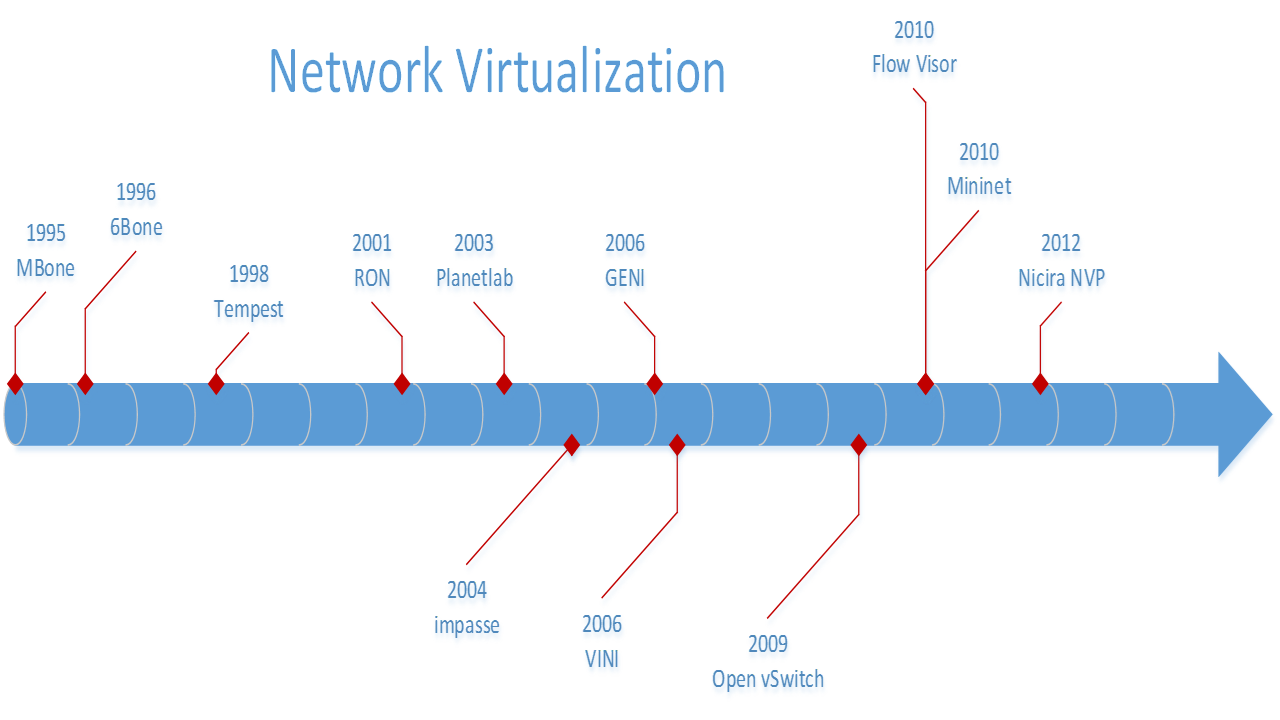
In previous article, I have discussed about historical perspective of Network virtualization ( http://www.dhimanchowdhury.blogspot.com/2015/07/network-virtualization-101-nve-overlay.html ): how the need to share resources and induce flexibility and programmability in network environment led to the series of research undertakings, e.g. MBone project (Almeroth, C.K., 2000) – an experimental backbone project for carrying IP “multicast” that was developed in 1994. If you have not read that article, I suggest that you do: it will help you understand the development in network virtualization and benefits thereof.

 
Figure 1. Timeline of Network Virtualization.

This article is third in the “Network Virtualization 101” series.

In the previous article, I presented a review of network programmability works in four stages rather than in chronological order: three stages were discussed in earlier section and the fourth “network virtualization” (NV) is presented herein as follows.

The notion of “network virtualization” (NV) can be understood as decoupling physical topology from logical topology (e.g., Overlay networks) and as such, implementation does not require SDN. Similarly, the common notion of SDN (separation of control plane and data plane) does not require network virtualization. This distinction is important since many may be confuse by the symbiotic nature in which network virtualization and SDN relate (Feamster, N., Rexford, J. & Zegura, E., 2014):

  •          SDN as enabling technology: with the advent of cloud computing, service providers faced the challenge to share and isolate resources to multiple tenants in a way that make best use of available network infrastructure. A common method to share such isolation at VM level is to use overlay networks through protocols such as VxLAN and NVGRE. While VxLAN and/or NVGRE does not require SDN to implement but having the capability to provision the network for VxLAN and/or NVGRE from centralized server surely helpful.  Another example of SDN as an enabling is Nicira’s network virtualization platform or NVP.  The NVP framework implements Open vSwitch (a virtual switching platform), a controller and South bound API to facilitate network transport. The Open vSwitch is hardware agnostic and can be implemented in servers without the need for networking gears.
  •         Slicing or virtualizing an SDN: A hybrid switch for example implements both traditional protocol suits and OF (OpenFlow) agents and other flow control APIs. With appropriate arbitration mechanisms, network flow can be logically separated from other logical instances of network. Similarly, Flowvisor (a special purpose controller that works as transport proxy between OF agent and OF controller) allows slicing of network resources and delegates control of each slice to a different controller (Flowvisor, 2014).


From historical perspective, the work on Network virtualization can be predated to the early days of MBone experiment. The MBone otherwise known as “Multicast Backbone” is a virtual network built on top of internet. It was invented by Van Jacobson, Steve Deering and Stephen Casner in 1992 as part of an undertaking by IETF (Internet Engineering Task Force).  In the early 1990s, majority of the routers in the internet did not support IP Multicasting and packets were transported through IP unicast. As a result one-to-many communication was difficult. The solution was MBone or “Multicast Backbone” in which multicast function provided by workstation running a daemon process known as “mrouted” (Almeroth, 2000). Workstation running “mrouted” process is known as “mrouter” (essentially a multicast router). These mrouters are than placed in special group of LAN or single LAN that are multicast capable. The “mrouted” process received unicast-encapsulated multicast packets on an incoming interface and then forwarded packets over the appropriate set of outgoing interfaces. Connectivity among these machines was provided using point-to-point, IP-encapsulated tunnels. Each tunnel is connected two endpoints via one logical link. The routing decisions were made using DVMRP (Distance Vector Routing Protocol) as shown the figure below.

 
Figure 2. MBone topology during the early years of its deployment.


The DVMRP since then replaced by PIM (Protocol Independent Multicast) helping MBone to be integrated with internet than its initial attempts. For many years, network equipment supported the creation of virtual networks, e.g. VLAN which allows the creation of multiple logical networks on top of physical topology. But such network virtualization is limited to L2 network segments and impedes on the deployment of new technologies traversing across the network. To overcome this, researchers and practitioner resorted to running overlay networks which allows endpoint nodes to run their own control plane and forward data traffic and control-plane message across the networks traversing multi hop L3 networks.  The MBone (for multicast) and 6Bone (for IPV6) are example of such overlay network virtualization. In the previous article, I discussed example of overlay network architecture and some of the protocol used for tunneling and will explore this further in the succeeding articles about network virtualization configurations. The complete survey of network virtualization is cumbersome, however, the historical perspective I am presenting herein, though brief, is important in the research of network programmability (SDN) and in the gradual development of programmable and dynamic network systems. It is to be noted both SDN and network virtualization is tightly coupled despite their distinctions. Programmable network (i.e. SDN) often presume “network virtualization” as an integral part to share network infrastructure for multi-tenant services supporting logical network topologies that differ from physical network. The early overlay network that is essential in evaluating and understanding “network virtualization” often used dedicated nodes running special protocols. The notion of such early day overlay network soon expanded to include any host computer that run special application in hope of supporting peer to peer file sharing application (e.g. Napster; Wikipedia, 2015). The research on peer to peer networking reignited interest and research works in the development of robust overlay network technologies. An example of such work is “Resilient Overlay Networks” (Andersen et al., 2015) in which a small number of network nodes form overlay network detecting network failure and recovering quickly from network issues and performance problem. Since overlay network does not require any special equipment (unlike Active network; please refer to my previous article), researchers began building experimental infrastructure like Planetlab (Peterson et al., 2002) to support wider research works on network virtualization. Interestingly, PlanetLab itself was a form of “programmable router/switch” active networking, but using a collection of servers rather than the network nodes, and offering programmers a conventional operating system (i.e., Linux) (Feamster, N., Rexford, J. & Zegura, E., 2014). The project of GENI (GENI, 2015) took this notion of programmable virtual network infrastructure to next level supporting much large scale national experimental for research in networking and distributed system.


Figure 3. GENI – The vast experimental virtualized network infrastructure project (GENI, 2015). Figure (Courtsey, GENI, 2015).

If you are interested in experimenting your concept in a virtualized network infrastructure, please visit http://groups.geni.net/geni/wiki/GENIConcepts and join the project.

Considering the project like GENI, one can easily perceive the potential of network virtualization. Some researchers argued that network virtualization is key to next generation internet architecture. In the first article of this series, discussing about NVE (Network Virtualization Environment) I explored the theoretical connotations from various scholars regarding the need for next generation internet and service provider network in which multiple network architectures can coexist at the same time (each optimized for different applications or requirements, or run by different business entities), and evolve over time to meet changing needs (Feamster, N., Rexford, J. & Zegura, E., 2014; Carapinha & Jiménez, 2009; Chowdhury & Boutaba, 2009; Chowdhury & Boutaba, 2008).

I hope this brief overview of NV (Network Virtualization) is helpful in understanding the difference and dependencies between network virtualization and SDN and the importance of network virtualization in future network design. You will find the basic understanding helpful in the succeeding articles about network architecture and configurations.

In the next article, I will extend the notion of Network Virtualization to VNF (Virtual Network Function) and NFV (Network Function Virtualization).  Please stay tune and follow me at linkedin (https://www.linkedin.com/in/dhiman1 ), twitter @dchowdhu ( https://twitter.com/dchowdhu ) and google plus (https://plus.google.com/u/0/+DhimanChowdhury/posts ). You may also subscribe to all these feeds through Agema System’s linkedin page at https://www.linkedin.com/company/agema-systems-inc?trk=top_nav_home

Reference

[Almeroth, C.K., 2000] Almeroth, C.K., 2000. The Evolution of Multicast: From the MBone to Interdomain Multicast to Internet2 Deployment. IEEE Network. Available online at http://www.cs.ucsb.edu/~almeroth/classes/F05.276/papers/evolution.pdf .

[Andersen et al., 2001] Andersen, D. G., Balakrishnan, H., Kaashoek, M. F. & Morris, R., 2015. Resilient Overlay Networks. In Proc. 18th ACM Symposium on Operating Systems Principles (SOSP), pages 131–145, Banff, Canada, Oct. 2001.

[Carapinha, J. & Jiménez, J. 2009] Carapinha, J. & Jiménez, J. 2009. VISA ’09 Proceedings of the 1st ACM workshop on Virtualized infrastructure systems and architectures. The ACM Digital Library.

[Chowdhury, K.M.M.N. & Boutaba, R., 2008 ] Chowdhury, K.M.M.N. & Boutaba, R., 2008. A Survey of Network Virtualization. Technical Report CS-2008-25. University of Waterloo.

[Chowdhury, K.M.M.N. & Boutaba, R., 2009 ] Chowdhury, K.M.M.N. & Boutaba, R., 2009. Network Virtualization: State of the Art and Research Challenges. IEEE COMMUNICATIONS MAGAZINE.

[Clark et al., 2006] Clark, D., Lehr, B., Bauer, S., Faratin, P., Sami, R. & Wroclawski, J., 2006. Overlay Networks and the Future of the Internet. Communications & Strategies, no. 63, 3rd quarter 2006, p. 109.

[Feamster, N., Rexford, J. & Zegura, E., 2014] Feamster, N., Rexford, J. & Zegura, E., 2014. The Road to SDN: An Intellectual History of Programmable Networks. ACM Queue, 2014.

Flowvisor, 2014. Flowvisor. Atlassian Confluence Open Source Project: University of Stanford. Available online at https://openflow.stanford.edu/display/DOCS/Flowvisor

[Feamster et al., 2004] Feamster, N., Balakrishnan, H., Rexford, J., Shaikh, A. & van der Merwe, J., 2004. The Case for Separating Routing from Routers. SIGCOMM’04 Workshops, Aug. 30-Sept. 3, 2004, Portland, Oregon, USA.

[GENI, 2015] GENI: Global Environment for Network Innovations. Available online at http://www.geni.net/.

[Peterson, et al., 2002] Peterson, L., Anderson, T., Culler, D. & Roscoe, T., 2002. A Blueprint for Introducing Disruptive Technology into the Internet. Planet Lab. Proceedings of the First ACM Workshop on Hot Topics in Networks (HotNets-I), Princeton, NJ, October 2002.


 [Wikipedia, 2015]. Wikipedia, 2015. Napster. Wikipedia: The free Encyclopedia. Available online athttps://en.wikipedia.org/wiki/Napster